General Networking Information
Cable Category and Description
1. Analog, Digital Voice
This category consists of basic telecommunications and power-limited circuit cables. There are no electrical performance test or bandwidth requirements for this classification.
2 ISDN(Data), 1.44Mbps, T1(1.544 Mbps), Digital Voice
This category consists of cables specified to 1 MHz.
3 10Base-T, ISDN, Voice
This is a performance designation for twisted-pair cable and connecting hardware that can support frequency transmission up to 16 Mhz, and data rates of 10 Mbps. Category 3 has the capability to support low speed data applications, performing to the acceptable minimum for 100 ohm cabling systems; however it is now primarily used for telephone wiring.
4 10Base-T, ISDN, Voice
This category consists of cables and connectors specified up to 20 MHz and data rates of 16 Mbps. Since the development of Category 5, Category 4 wiring systems are rarely used.
5 100 MHz solution
Suitable for 10BaseT, 100BaseTX, 16Mbps Token ring and 155ATM
Ideally used in applications where high bandwidth is unlikely to be required
5E 100 - 155MHz solution
Suitable for Gigabit Ethernet, 10BaseT, 100BaseTX, 16Mbps Token Ring and 155/622ATM
Ideally used for higher bandwidth applications
6 200Mhz + solution
Suitable for all above applications
This is the maximum future proofing available for structured cabling today.
A Little Theory
Now, bear with me, you need to understand some of this stuff...
The 10BASE-T and 100BASE-TX Ethernets consist of two transmission lines. Each transmission line is a pair of twisted wires. One pair receives data signals and the other pair transmits data signals. A balanced line driver or transmitter is at one end of one of these lines and a line receiver is at the other end. A (much) simplified schematic for one of these lines and its transmitter and receiver follow:
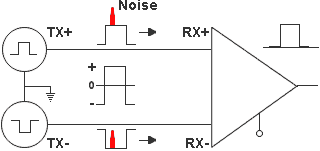
Pulses of energy travel down the transmission line at about the speed of light (186,000 miles/second). The principal components of one of these pulses of energy is the voltage potential between wires and current flowing near the surface of the wires. This energy can also be considered as residing in the magnetic field which surrounds the wires and the electric field between the wires. In other words, an electromagnetic wave which is guided by, and travels down the wires.
The main concern is the transient magnetic fields which surrounds the wires and the magnetic fields generated externally by the other transmission lines in the cable, other network cables, electric motors, fluorescent lights, telephone and electric lines, lightning, etc. This is known as noise. Magnetic fields induce their own pulses in a transmission line which may literally bury the Ethernet pulses, the conveyor of the information being sent down the line.
The twisted-pair Ethernet employs two principle means for combating noise. The first is the use of balanced transmitters and receivers. A signal pulse actually consists of two simultaneous pulses relative to ground: a negative pulse on one line and a positive pulse on the other. The receiver detects the total difference between these two pulses. Since a pulse of noise (shown in red in the diagram) usually produces pulses of the same polarity on both lines one pulse is essentially canceled by out the other at the receiver. Also, the magnetic field surrounding one wire from a signal pulse is a mirror of the one on the other wire. At a very short distance from the two wires the magnetic fields are opposite and have a tendency to cancel the effect of each other out. This reduces the line's impact on the other pair of wires and the rest of the world.
The second and the primary means of reducing cross-talk--the term cross-talk came from the ability to (over) hear conversations on other lines on your phone--between the pairs in the cable, is the double helix configuration produced by twisting the wires together. This configuration produces symmetrical (identical) noise signals in each wire. Ideally, their difference, as detected at the receiver, is zero. In actuality it is much reduced.
The above was sourced from the 9th Tee
Invention of Ethernet
The following is an excerpt from Ethernet:The Definitive Guide by Charles Spurgeon (O'Reilly and Associates, 2000):
“In late 1972, Metcalfe and his Xerox PARC colleagues developed the first experimental Ethernet system to interconnect the Xerox Alto, a personal workstation with a graphical user interface.
The experimental Ethernet was used to link Altos to one another, and to servers and laser printers. The signal clock for the experimental Ethernet interface was derived from the Alto's system clock, which resulted in a data transmission rate on the experimental Ethernet of 2.94 Mbps.
Metcalfe's first experimental network was called the Alto Aloha Network. In 1973 Metcalfe changed the name to "Ethernet," to make it clear that the system could support any computer-not just Altos-and to point out that his new network mechanisms had evolved well beyond the Aloha system.
He chose to base the name on the word "ether" as a way of describing an essential feature of the system: the physical medium (i.e., a cable) carries bits to all stations, much the same way that the old "luminiferous ether" was once thought to propagate electromagnetic waves through space. Thus, Ethernet was born.”
Types of Networks
- 10Base2
-
Is 10MHz Ethernet running over thin, 50 Ohm baseband coaxial cable. 10Base2 is also commonly referred to as thin-Ethernet.
Limited to 185 meters (607 ft) per unrepeated cable segment.
- 10Base5
-
Is 10MHz Ethernet running over standard (thick) 50 Ohm baseband coaxial cabling.
Limited to 500 meters (1,640 ft) per unrepeated cable segment.
- 10BaseF
-
Is 10MHz Ethernet running over fiber-optic cabling.
depends on the signaling technology and medium used but can go up to 2KM.
- 10BaseT
-
Is 10MHz Ethernet running over unshielded, twisted-pair cabling.
- 10Broad36
-
Is 10MHz Ethernet running through a broadband cable.
Limited to 3,600 meters (almost 2.25 miles).
- 100BaseFX
-
100-Mbps baseband Fast Ethernet specification using two strands of multimode fiber-optic cable per link. To guarantee proper signal timing, a 100BaseFX link cannot exceed 400 meters in length.
Based on the IEEE 802.3 standard.
- 100BaseT
-
100-Mbps baseband Fast Ethernet specification using UTP wiring. Like the 10BaseT technology on which it is based, 100BaseT sends link pulses over the network segment when no traffic is present.
However, these link pulses contain more information than those used in 10BaseT.
Based on the IEEE 802.3 standard. Also known as Fast Ethernet.
- 100BaseTX
-
100-Mbps baseband Fast Ethernet specification using two pairs of either UTP or STP wiring. The first pair of wires is used to receive data; the second is used to transmit. To guarantee proper signal timing, a 100BaseTX segment cannot exceed 100 meters in length.
- 100BaseX
-
100-Mbps baseband Fast Ethernet specification that refers to the 100BaseFX and 100BaseTX standards for Fast Ethernet over fiber-optic cabling. Based on the IEEE 802.3 standard. Also known as Fast Ethernet, and IEEE 802.3.
Based on the IEEE 802.3 standard. Also known as Fast Ethernet.
Glossary of Network Terms
- ANSI
-
"American National Standards Institute" - A definer of standards of all kinds, including FDDI.
- Appletalk
-
A protocol family developed by Apple Computer to implement LANs serving Macintoshes.
- Bridge
-
A network "relay" which reads, buffers, and sends data to relay it from one data link to another, but makes the two data links appear as one to levels higher than the data link layer.
- Dialup Modem
-
Modem used over ordinary dial-up telephone lines as opposed to private or leased lines.
- FTP
-
Protocol in the "TCP/IP" family for copying files from one computer to another. Stands for "File Transfer Protocol".
- Gateway
-
A type of "network relay" that attaches two networks to build a larger network. Modern "narrow" usage is that it is one that translates an entire stack of protocols, e.g., translates TCP/IP-style mail to ISO-style mail. Older usage used it for other types of relays--in particular, in the "TCP/IP" world, it has been used to refer to what many now insist is a "router".
- NFS "Network File System"
-
an IP-based protocol originally developed by Sun Microsystems which provides file services.
- Protocol
-
The "rules" by which two network elements trade information in order to communicate. Must include rules about a lot of mundane detail as well as rules about how to recover from a lot of unusual communication problems. Thus they can be quite complicated.
- Relay
-
One terminology uses the term "relay" as a device that interconnects LANs, different kinds of relays being repeaters, bridges, routers, and gateways.
- Repeater
-
In the "Ethernet" world, a "relay" that regenerates and cleans up signals, but does no buffering of data packets. It can extend an Ethernet by strengthening signals, but timing limitations on Ethernets still limit their size.
- Router
-
A network "relay" that uses a protocol beyond the data-link protocol to route traffic between LANs and other network links.
- Routing Protocol
-
a protocol sent between routers by which routers exchange information own how to route to various parts of the network. The TCP/IP family of protocols has a bunch, such as RIP, EGP, BGP, OSPF, and dual IS-IS.
- SMTP "Simple Mail Transfer Protocol"
-
the protocol in the TCP/IP family used to transfer electronic mail between computers. It is not oriented towards a client/server system so other protocols (see "POP") are often used in that context. However, servers will use SMTP if they need to transfer a message to another server.
- SNMP "Simple Network Management Protocol"
-
Originally developed to manage IP based network equipment like routers and bridges, now extended to wiring hubs, workstations, toasters, jukeboxes, etc. SNMP for IPX and AppleTalk under development. Widely implemented. See CMIP.
- TCP/IP
-
"Transmission Control Protocol/Internet Protocol" - literally, two protocols developed for the Defense Data Network to allow their ARPANET to attach to other networks relatively transparently. The name also designates the entire family of protocols built out of IP and TCP. The Internet is based upon TCP/IP.
- TELNET
-
a protocol in the TCP/IP family that is used for "remote login". The name is also often used as the name of the client program that utilizes the TELNET protocol.
- Terminal Server
-
a network device that allows a number of terminals to attach to a LAN, and do remote logins across the LAN.
- Token Ring
-
In the more general sense of the word, a type of LAN that has stations wired in a ring, where each station constantly passes a special message (a "token") on to the next. Whoever has the token can send a message.
- Tunnelling
-
An important concept in the design of many kinds of networks: taking some protocol-family's ability to move packets from user to user, or to open virtual-circuits between users, and use this as if it were a data-link protocol to run another protocol family's upper layers (or even the same protocol family's upper layers). Examples: running TCP/IP over Appletalk instead of something like Ethernet; running Appletalk over DECnet instead of something like Localtalk or Ethernet.