Siting the Fan Correctly
Kitchens
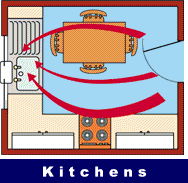
A fan should always be sited in the furthest window or wall from the main source of air replacement to avoid short-circuiting the airflow.
It should be located as high as possible in the window or wall nearest to smells or steam, but not directly above eye-level grills or cooker hoods.
If the room contains a fuel burning device (such as a gas boiler) with a non-balanced flue, it is essential that there is enough replacement air to prevent fumes being drawn down the flue when the fan is extracting to its utmost capacity.
Bathrooms
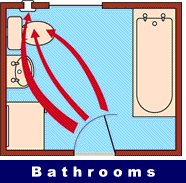
IEE Regulations (U.K.) require that a conventional mains voltage fan in a bathroom or shower must be located where it cannot be touched by a person using the bath or shower and well away from any water spray.
Alternatively, the new TLC range of 12 volt S.E.L.V. (Safety Extra Low Voltage) fans are specifically designed for the safe ventilation of toilets, bathrooms and shower rooms and can be fitted within the splash area with absolutely no risk of electric shock.
Stale air is also removed by installing the appropriate TLC fan.
In certain circumstances, such as in toilets, a timer is incorporated to provide an automatic run-on period of 15 minutes as stipulated in The Building Regulations.
General
Ventilation units should be placed as high as possible in the window or wall near any local smells and steam but not directly above eye level grills, cookers or direct sources of heat in excess of +40°C. Do not sight in areas containing excessive levels of grease without suitable filters.
In large rooms the extract points should be well and safely distributed to obtain even ventilation in all areas. A short circuit of airflow will be avoided by siting units as far away as practicable from the main source of air replacement.
Maintenance
Site the fan so that it is accessible for regular periodic cleaning and servicing. Make sure that grilles, motor cooling ports and impellers are able to function freely in accordance with guarantee requirements.
Electrical equipment should be isolated before carrying out any maintenance or cleaning. All fans should be regularly cleaned and checked, (every month or so, dependent on usage). Bearings should be oiled where appropriate twice a year, unless stated otherwise.
Ducted Applications
Ducts passing through an unheated roof void should be insulated to minimise condensate formation and must include a condensation trap and a means of running off condensate.
Vertical ducts should be fitted with a condensation trap and a weather proof cowl of sufficient free area for the air volume. Horizontal ducts should fall away from the fan unit.
Installing a fan in a ceiling
First check that there are no joists, pipes or cables above the area where the fan will be located.
Ducting must be used when steam and or condensation are likely to occur, unless venting directly to the outside.
If installing in a position where condensation is likely to run back towards the fan you will need to install a condensation trap as near to the fan as possible.
If installing in an unheated roof void, ducting or soil pipe should be insulated to minimise condensation forming.
Work out the route that the ducting will take and the total length required. You will need an external grille to match the ducting diameter.
Centrifugal Fans
These are pressure developing fans. This means they are capable of overcoming the resistance encountered in a ducted system. This is particularly useful in applications such as internal toilets and bathrooms or washrooms where there is no direct access to the outside.
Wall Bathroom Fans
Operating l2Volts Low Volt bathroom fans provide can be installed in complete safety virtually anywhere in the bathroom. These fans operate on 12 volts, ( transformer is required )
Wall Mounting a Fan
Check that your chosen location has no buried pipes or cables, and that the wall outside is not obstructed by a drain pipe.
Fitting a Fan in a Window
It is advisable to have the hole pre cut by a professional glazier.
NB Your glass supplier will provide you with advice concerning the weight/type of glass necessary for your specification, essential where fans are to be installed in roof light situations.
Rooms with Double Glazing
The Xpelair range GX and DX models may be installed in a hermetically sealed double glazing system if a special sealed unit (with the correct size hole pre-cut) is obtained from the double glazing manufacturer. DX l 00 models will also require a double glazing kit, Catalogue Reference XP DXDG.
For installing the GX models into secondary glazing and casement windows use the double window kit, XP GXDW